



How to Offboard Employees Safely With an Offboarding Checklist

Oct 31, 2026
Last updated on Oct 31, 2026
A good offboarding process decides whether a company keeps or loses its data, knowledge, and reputation when someone leaves. The real risk is not the moment an employee resigns, but the gap between their last working day and the point where every access, asset, and obligation is closed. The checklist below closes that gap in a structured way.
Key Takeaways
- The biggest risk when an employee leaves is not the resignation letter but the access that is never revoked. Nearly 90% of former employees keep access to at least one company system after they go, which makes weak offboarding a security gap rather than an administrative task.
- Offboarding and contract termination are two different things. One is the operational process of handing over people and assets; the other is the legal procedure. A complete employee offboarding checklist has to cover both layers.
- A strong offboarding process runs across three stages: before the last day for handover and asset recovery, the last day for revoking all access and running the exit interview, and after departure for final settlement within the statutory window and closing the social insurance book.
- A well-run exit does more than close risk. It preserves knowledge, protects the employer brand, and keeps the door open for strong talent to return.
Offboarding is the handover process when an employee leaves the organization, spanning people, security, and legal duties. It is not a form to sign off. This article gives an offboarding checklist organized into three time stages, so a company closes every exit cleanly instead of leaving risk open.
What offboarding is, and how it differs from termination
Offboarding is the full process a company runs when an employee leaves, whether through voluntary resignation, contract expiry, or restructuring. It centers on people and operations: handing over work, recovering assets, closing access, and keeping a relationship with the person who leaves.
Many companies confuse offboarding with the procedure to terminate a labor contract. Termination is the legal layer, covering the decision, the notice, and the statutory obligations. Offboarding is the operational layer around it. Just as a well-run onboarding program decides how well someone starts, offboarding decides how safely they leave, for both sides.
Three offboarding gaps companies overlook
When an offboarding process lacks structure, the losses rarely show up immediately. Three gaps are the most common, and all of them are quiet.
The first gap is security. Nearly 90% of former employees still have access to at least one company system after they leave. Every unlocked account and every unchanged shared password is an open door to customer, financial, and proprietary data. Speed matters too: about one in three organizations take more than 24 hours to revoke a departing employee’s access, long enough for data to move out of reach.
The second gap is knowledge. A departing employee carries undocumented processes, client relationships, and workarounds that were never written down. Without a handover plan, most of that knowledge leaves with them, and automating the offboarding process fixes the sequence in place instead of relying on one person’s memory.
The third gap is legal exposure and brand. Late payments, an unclosed social insurance book, or an incomplete handover create disputes and damage the employer brand. Even how a company lets an employee go shapes that final impression. A bad exit travels faster than any recruitment campaign.
The offboarding checklist in three stages
A good checklist ties each task to a stage and an owner. The three groups below cover both the operational and the legal layer, and they apply to any employee exit.
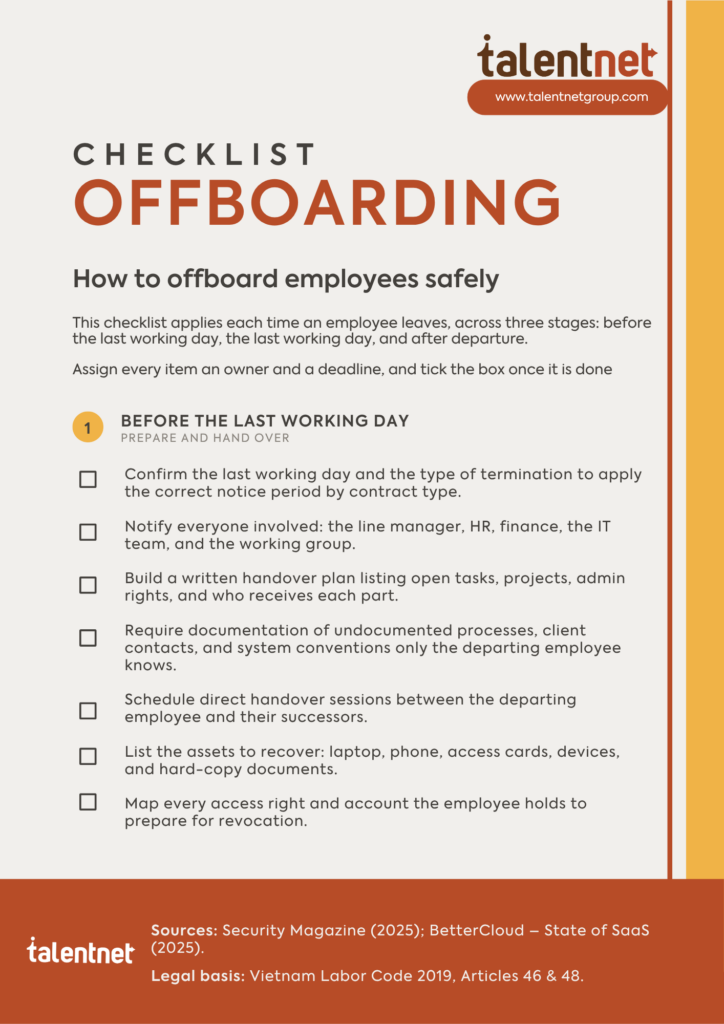
[Download the full offboarding checklist]
The after-departure group carries the highest legal risk and should not slip. Within 14 working days of the termination date, the company must pay the final salary, unused annual leave, and severance pay where applicable, then close the social insurance book and return the original documents it holds. This is where a rushed handover most often turns into a dispute, and a standing HR compliance checklist keeps those duties visible.
Turn offboarding into a system for retention and brand
The real strength of offboarding is not closing risk, but turning an ending into a long-term asset. Three moves make that difference.
First, turn handover into a knowledge-retention mechanism, so each exit leaves updated documents and processes instead of a gap. Second, cultivate an alumni network, because people who leave on good terms can return with new experience, refer talent, or become clients. Third, standardize the process across the organization so every department and every site runs it the same way, which matters most for multi-site companies.
For companies without the resources to run this consistently at every step, HR outsourcing and compliance advisory standardize the whole chain, from handover to closing the social insurance book and final settlement. Offboarding then stops being something each manager improvises and becomes a process you can measure and repeat.
Conclusion
An employee’s exit is a test of a company’s entire HR system. The immediate move is to tie each step in the three stages to an owner and a clear deadline. Talentnet’s HR outsourcing services standardize this process, from handover to closing every legal obligation, for companies of any size.
HR reports
Download presentations, useful documents and more in our library
Get them nowRelated insights



Solve your HR problems!
6th Floor, Star Building, 33 Mac Dinh Chi, Saigon Ward, Ho Chi Minh city, Vietnam